.png)


The Alpine Divorce Didn't Begin on TikTok. It Began in 1896.
- frankachiedu
- 23 hours ago
- 2 min read

More than 15 million TikTok posts have turned the phrase Alpine Divorce into one of the internet's most unsettling conversations.
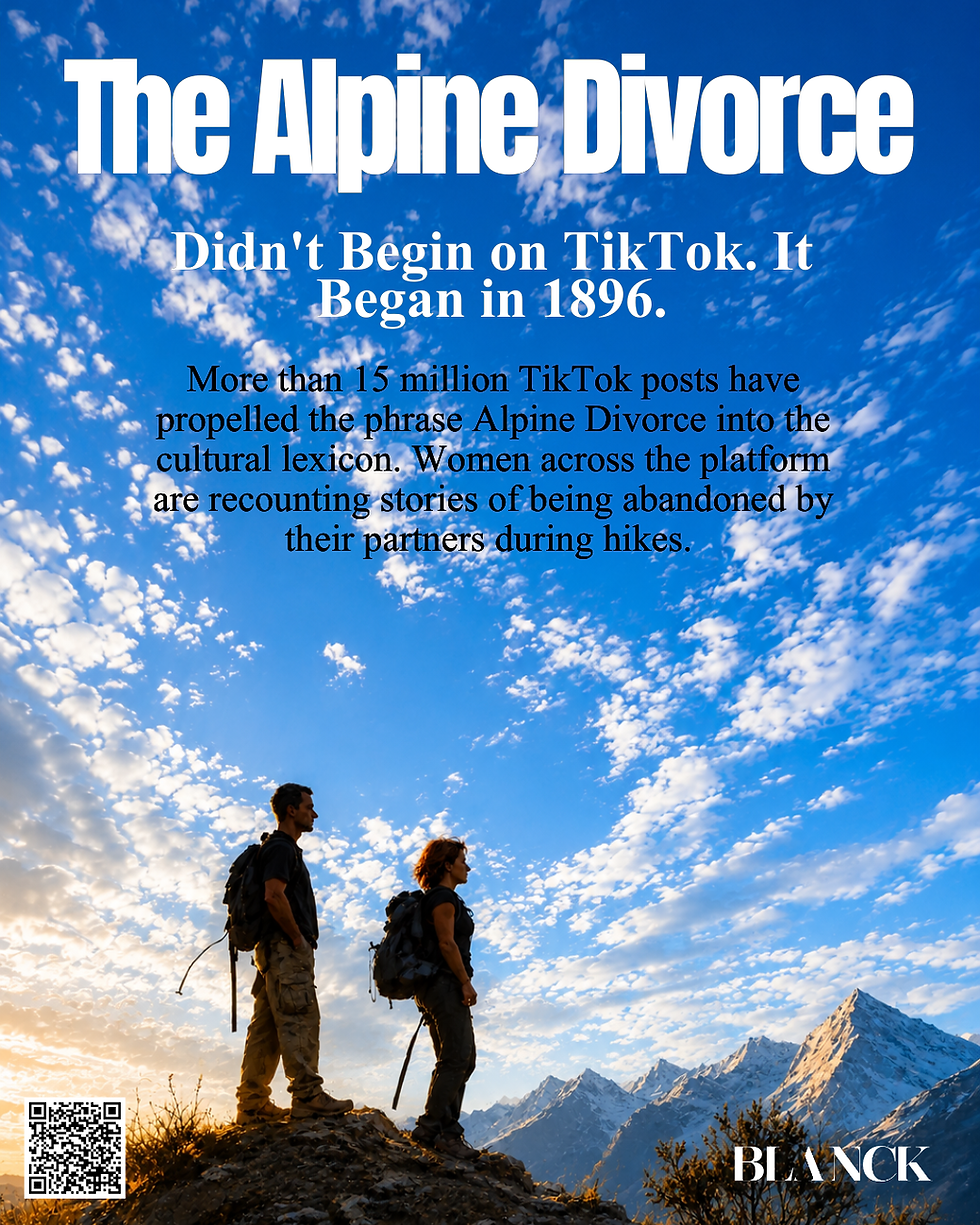
What began as women sharing eerily similar experiences has evolved into an empowering community of people recounting the moment they were abandoned by a partner during a hike. Some describe being left behind after an argument. Others say their partners simply kept walking, refusing to slow down or check whether they were safe. While not every story ended in tragedy, the emotional impact was strikingly similar.
The mountain, it seems, has become more than a backdrop.
It has become a metaphor. But here's what many people don't realise: the term Alpine Divorce predates social media by more than a century. It originates from An Alpine Divorce, an 1896 short story by Scottish-Canadian author Robert Barr. In the story, a husband takes his wife to the Swiss Alps, intending to murder her and disguise her death as an accident. Long before TikTok gave the phrase new meaning, the mountain had already been imagined as a place where betrayal could hide in plain sight.

Today's viral trend is, of course, very different. No one is suggesting that every partner who walks ahead on a trail has murderous intentions. Yet the symbolism is impossible to ignore. Because the conversation isn't really about hiking.
It's about what happens when the person who claims to love you chooses impatience over partnership, ego over empathy, and reaching the summit over making sure you both get there safely.
Mountains have a way of stripping people back to who they really are. There are no carefully curated social media personas, no performative declarations of love, no audience to impress.
There is only one question:
What do you do when the person beside you becomes vulnerable?
Do you slow down?
Do you wait?
Do you offer your hand?
Or do you keep walking?
Perhaps that's why the Alpine Divorce has resonated with millions. It has given a name to a feeling that extends far beyond hiking trails-the quiet realisation that you've been carrying a relationship alone.
Being left behind on a mountain mirrors something many people have experienced emotionally: partners who dismiss your fears, rush your healing, minimise your struggles, or make you feel like a burden simply because you cannot move at their pace.
Healthy relationships aren't measured by who reaches the top first. They're measured by whether both people arrive together.
The viral stories may begin on mountain trails, but they raise much bigger questions about emotional safety, compassion and what true partnership looks like. The strongest person in a relationship should never use their strength to create distance.
They should use it to make the journey safer for both. Perhaps that is the real lesson behind the Alpine Divorce. Long before someone leaves you on a mountain, they may have already left you in the relationship. Sometimes the hardest part of the climb isn't the mountain.
It's realising you've been climbing alone all along.



Comments