.png)


CUT THE CRAP: The Fashion Industry Has a Class Problem


Fashion loves to talk about diversity, individuality and breaking barriers. But behind the glamorous campaigns, exclusive invitations and carefully curated conversations about inclusion lies an uncomfortable truth: the industry remains deeply invested in class, status and social hierarchies. And perhaps it's time we stopped pretending otherwise.
I've always loved fashion. I come from a family with a deep enthusiasm for it, although I stumbled into the industry almost entirely by chance. And while I've spent years writing about fashion, working within its orbit and observing the people who make it what it is, I have never quite felt at home in it.
There's just something about the classism that churns my stomach. The carefully constructed hierarchies. The unspoken rules of belonging. The obsession with being seen in the right places, wearing the right things and knowing the right people. The exhausting performance of importance in an industry where appearances are often mistaken for substance.

And perhaps what fascinates me most is how committed everyone seems to be to keeping up the illusion. Even when some of the industry's familiar faces are clutching on to their last account balance for dear life, there they are, standing tall in their six-inch heels, sashaying from one corner of the room to another, hungry for attention, desperate to remain visible.
Because in fashion, God forbid anyone discovers that the emperor has no clothes. Or worse, that the emperor cannot afford them. And it doesn't matter whether you're in Lagos, London, Paris or New York. There seems to be an invisible thread connecting the industry's social circles. The same unspoken mean-girl rules. The same subtle exclusions. The same obsession with who is in, who is out and who has suddenly become important enough to acknowledge.
It's almost comical how an industry that prides itself on individuality can be so fiercely conformist.
You can be extraordinarily talented, knowledgeable and hardworking, but if you don't understand the social choreography, you may find yourself permanently standing outside the circle.
And sometimes, even when you're invited in, you realise you have absolutely no desire to stay.
You're Invited. Just Not That Invited.
I recently watched a woman explain the elaborate process through which luxury fashion houses such as Chanel and Prada determine who gets invited to their runway shows.
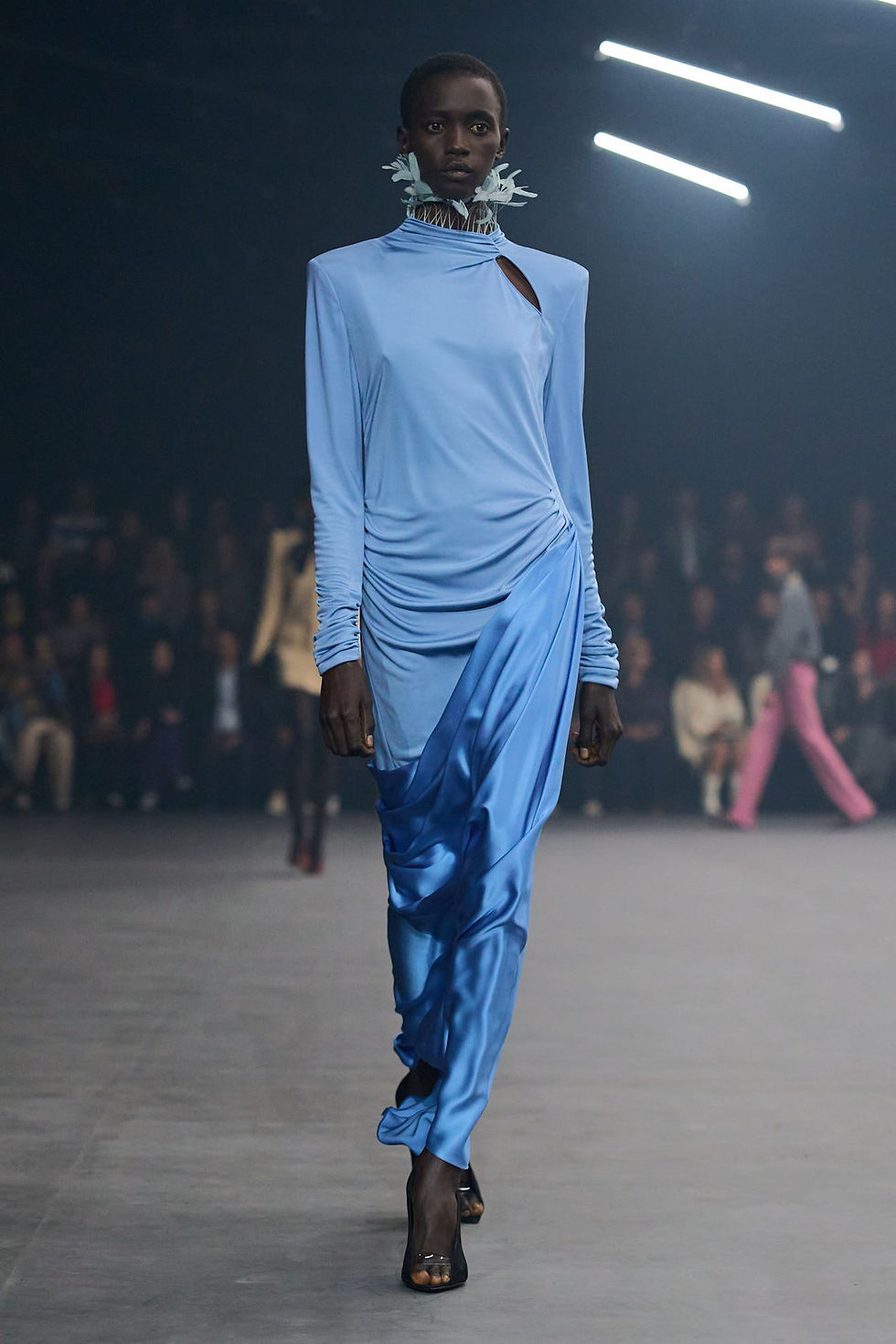
And honestly, I couldn't quite wrap my head around it. Not because I don't understand exclusivity. I do. Luxury fashion is, after all, built partly on the idea that not everyone can have access to everything. There are only so many seats at a fashion show, and naturally, brands have commercial relationships, celebrities, buyers and important guests to consider.
But there's something about the industry's obsession with categorising people according to their perceived importance that I find deeply unsettling. It reminded me of an event I attended in London last year, organised by a fashion council.
There were two different entrances.
And despite having a ticket to attend, you weren't permitted to set foot on the red carpet unless you possessed a particular category of invitation.
Imagine that.
You were important enough to be invited, but apparently not important enough to walk through a particular door. Now, before anyone reminds me about VIP protocols, security arrangements and the logistics of managing high-profile events, I understand all of that.
My issue isn't that everyone should have identical access to every space. It's the culture surrounding these distinctions. The almost theatrical way fashion communicates who matters more, who deserves visibility and who should quietly make their way through the other entrance.

The industry has perfected the art of making people feel privileged to be included while simultaneously reminding them of their position within its hierarchy. You may have a ticket, but not that ticket. You may be on the guest list, but not that guest list. You may be welcome in the room, but apparently not important enough to be photographed entering it.
And somehow, we've normalised this. In fashion, the invitation itself has become a form of social currency. Where you sit, which entrance you use, who acknowledges you and whether your presence is documented can carry almost as much significance as the event itself.
I sometimes wonder how much energy the industry spends creating beautiful clothes and how much it spends reminding people where they stand. Because there's a difference between creating an exclusive experience and making exclusion part of the experience. And sometimes, I wonder whether fashion knows the difference.

The Price of Admission
But the class problem goes far beyond invitations and red carpets. Fashion is one of those industries where being talented is important, but being able to afford the opportunity to demonstrate that talent can be equally consequential.
Consider the young aspiring stylist expected to work for little or no pay while assisting on editorial shoots. The fashion journalist who must somehow finance a life in London, Paris or New York on an entry-level salary. The emerging designer who needs thousands to produce a collection, organise a presentation and get the right people into the room.
Now consider the person who can afford to do all those things because someone else is paying their rent. Both may be equally talented. Both may work equally hard. But only one has the luxury of treating financial uncertainty as an investment in their future.
And that is where the inequality begins.
We romanticise the struggle of young creatives. We celebrate the assistant who worked their way up, the designer who slept in their studio and the editor who spent years fetching coffee before finally landing their dream job.
But what about the talented people who couldn't afford to wait? The ones who had bills to pay, children to raise, families to support or simply no financial safety net? We rarely hear their stories because, quite frankly, they often never make it far enough into the industry to tell them.
Fashion doesn't just reward talent. It rewards the ability to survive long enough for talent to be recognised. It's Not What You Know. It's Who Knows You. There is an unspoken currency in fashion, and it isn't necessarily money.
It's access.
Access to the right rooms, the right parties, the right publicists, the right editors and the right people who can make one phone call and change the trajectory of a career.
Fashion thrives on relationships. That, in itself, is not unusual. Most industries do. But fashion has elevated networking into something resembling a social caste system. There are the people who are invited, the people who are tolerated and the people who spend years trying to get through the door.
An invitation to a fashion show isn't always about professional relevance. A seat at a prestigious dinner isn't necessarily a reflection of contribution. And being described as an industry insider can sometimes have less to do with what you've accomplished than with who is willing to acknowledge you publicly.
Of course, relationships matter. Nobody is suggesting otherwise. But when opportunity circulates repeatedly within the same networks, it becomes increasingly difficult to distinguish merit from proximity.And perhaps the most frustrating thing about this system is that it rarely announces itself.Nobody sends you an email explaining that you weren't considered because you don't belong to the right social circle. You simply stop getting invited.
Or worse, you were never on the list to begin with. The Diversity Conversation Is Conveniently Incomplete. Over the past decade, fashion has become increasingly vocal about diversity.
We have seen campaigns featuring models of different races, ages, body types and abilities. Conversations about representation have become mainstream, and brands are now far more conscious of how their imagery reflects the world around them.
These developments matter. But representation is only one part of inclusion. What good is diversity on the runway if the pathway into the industry remains accessible primarily to people with financial privilege and social connections? A campaign featuring a diverse cast does not automatically mean the creative team behind it is equally diverse.

A fashion house celebrating African craftsmanship does not necessarily mean African creatives have meaningful influence over how their cultures are represented. And an industry that enthusiastically celebrates emerging talent cannot claim to be entirely inclusive if its opportunities remain inaccessible to those without financial backing. Class is often missing from the diversity conversation because it is considerably more uncomfortable to confront.
Race and gender can be addressed, at least superficially, through casting decisions and public-facing campaigns. Class requires something more structural. It requires examining who gets hired, how much people are paid, who receives opportunities and why certain individuals appear to move through the industry with considerably less resistance than others.
That conversation is far less glamorous. And perhaps that is why we don't have it nearly enough. The African Creative and the Geography of Privilege For African creatives, the issue becomes even more complicated. Fashion may have become increasingly fascinated with African creativity, but the centres of influence remain largely concentrated in a handful of Western fashion capitals.
An exceptionally talented designer working in Lagos, Accra or Nairobi may have the creativity, technical ability and cultural relevance to compete internationally. Yet their opportunities for global visibility can depend heavily on access to international buyers, editors, investors and established industry networks.
Travel costs money. Visa applications can be expensive and uncertain. Producing internationally competitive collections requires resources. Building relationships across continents demands time and financial commitment.
Meanwhile, a similarly talented designer based in London or Paris may benefit from proximity to institutions, established networks and commercial opportunities.
This is not to suggest that Western-based designers have it easy. Far from it. But geography can create its own hierarchy of access. And there is something deeply ironic about an industry that celebrates African creativity while so much of the power to validate that creativity remains elsewhere. Why should an African designer need recognition from Paris before their work is considered internationally significant? Why does international validation so often become the benchmark for local excellence?
And who decided that proximity to Western fashion institutions should determine the value of creativity emerging from elsewhere? These are questions worth asking. Because fashion's class problem isn't simply about wealthy people and everyone else. It is also about the global distribution of power, opportunity and cultural authority. The Nepo Baby Conversation Barely Scratches the Surface. We have become fascinated by the rise of the so-called nepo baby.
The children of famous actors, musicians, designers and wealthy families who appear to glide into modelling contracts, luxury campaigns and coveted creative positions. And while the conversation often focuses on whether these individuals deserve their opportunities, I think we're missing the bigger picture. The problem isn't necessarily that privileged people are talented or successful. Some undoubtedly are.
The problem is that their privilege often provides a level of access that others must spend years trying to obtain. A young model with famous parents may have access to agents, photographers and casting directors long before their first professional booking. An aspiring designer from a wealthy family may be able to launch a label without the immediate pressure of profitability. A fashion entrepreneur with influential connections may secure press coverage that an equally innovative independent designer struggles to obtain.None of this automatically invalidates their talent.
But pretending everyone started from the same position is intellectually dishonest. And the industry's obsession with presenting success as the inevitable reward for hard work only reinforces that dishonesty. Because sometimes the difference between two equally talented people isn't ambition. It's a surname, a bank balance or an introduction.
The Performance of Belonging
Perhaps one of fashion's most peculiar contradictions is that even those working within the industry can feel pressured to perform a lifestyle they cannot afford. Fashion is not simply an industry that sells aspiration. It often expects its workers to embody that aspiration. The right clothes. The right restaurants. The right events. The right social circles. There is an aesthetic associated with belonging, and maintaining it can be expensive.
Wealth, or at least the appearance of it, can become a form of professional credibility. And in an industry where perception is currency, the pressure to look successful before becoming successful can be enormous. There is something almost absurd about a young creative earning a modest salary while working to sell a luxury lifestyle to people who can afford it. Yet this contradiction rarely attracts the same scrutiny as the industry's latest controversy.
Perhaps because we have become so accustomed to the spectacle that we forget to question the machinery behind it. And this is where my fascination with fashion often gives way to exhaustion. I have watched people navigate rooms as though their very existence depends on being acknowledged by someone considered more important. I've seen the energy invested in being visible, relevant and socially connected.
And I sometimes wonder what would happen if we redirected even half that energy towards celebrating the actual work. The designers. The craftspeople. The photographers. The stylists. The people whose creativity gives the industry something worth talking about in the first place. Because somewhere along the way, fashion appears to have confused being seen with being significant.
So, Who Gets Left Behind?
I find myself increasingly interested in the people whose names never appear in fashion's success stories. The talented photographer who couldn't afford to keep shooting for exposure. The stylist who abandoned their ambitions because the unpaid work became unsustainable. The independent magazine that couldn't compete with publications backed by wealthy investors. The designer whose collection never reached an international showroom because they couldn't afford the journey.

The creative who wasn't born into the right network and never managed to break into it. These people are not necessarily less talented, less ambitious or less deserving. They are simply less visible. And perhaps that is fashion's greatest class problem. We have built an industry that celebrates the people who make it while paying remarkably little attention to the conditions that determine who gets the chance.
Cut the Crap. Let's Talk About Real Inclusion. I don't believe the answer is to demonise privilege. Wealthy people are entitled to pursue creative careers. Children of famous parents are entitled to have ambitions. And relationships will always play a role in industries built around collaboration.
But we should stop pretending that opportunity is distributed fairly. If fashion is serious about inclusion, the conversation must extend beyond who appears in campaigns and who walks the runway.
It must include fair pay, transparent recruitment, accessible internships, investment in emerging creatives, opportunities outside traditional fashion capitals and a willingness to challenge the closed networks that determine so much of the industry's success.
It must also recognise that the people who cannot afford to work for free are not somehow less passionate about fashion. And that those who lack influential connections are not necessarily less deserving of a seat at the table. Fashion has always been exceptionally good at selling the dream. Perhaps it's time it became equally committed to making the dream accessible.
As for me, I've come to accept that I am quite happy writing about fashion without necessarily wanting to belong to its inner world. I love the creativity. I love the clothes, the craftsmanship, the stories and the people who genuinely have something to contribute. I love what fashion represents as an expression of culture, identity and imagination.
But the industry itself? That's another conversation entirely. Because somewhere between the creativity and the commerce, fashion has built a social ecosystem in which access is currency, proximity is power and the appearance of success can sometimes matter more than success itself. And I have absolutely no desire to spend my life trying to convince someone behind a velvet rope that I deserve to be on the other side.

I love fashion. I just don't particularly care for the performance of belonging to it. Perhaps that's why I've never quite felt at home in the industry. Or perhaps I've simply realised that the industry isn't a real place. It's a carefully constructed world where everyone is playing a part, everyone is watching everyone else, and far too many people are pretending not to notice that the whole thing is a performance.
Cut the crap.
Fashion doesn't have a talent shortage. It has an access problem. And until we address that, all the conversations about diversity and inclusion will remain, at best, incomplete.



Comments