.png)


The Beauty Industry Sells Empowerment. But It Profits From Insecurity.
- ibrahimaishanana24
- 14 hours ago
- 2 min read
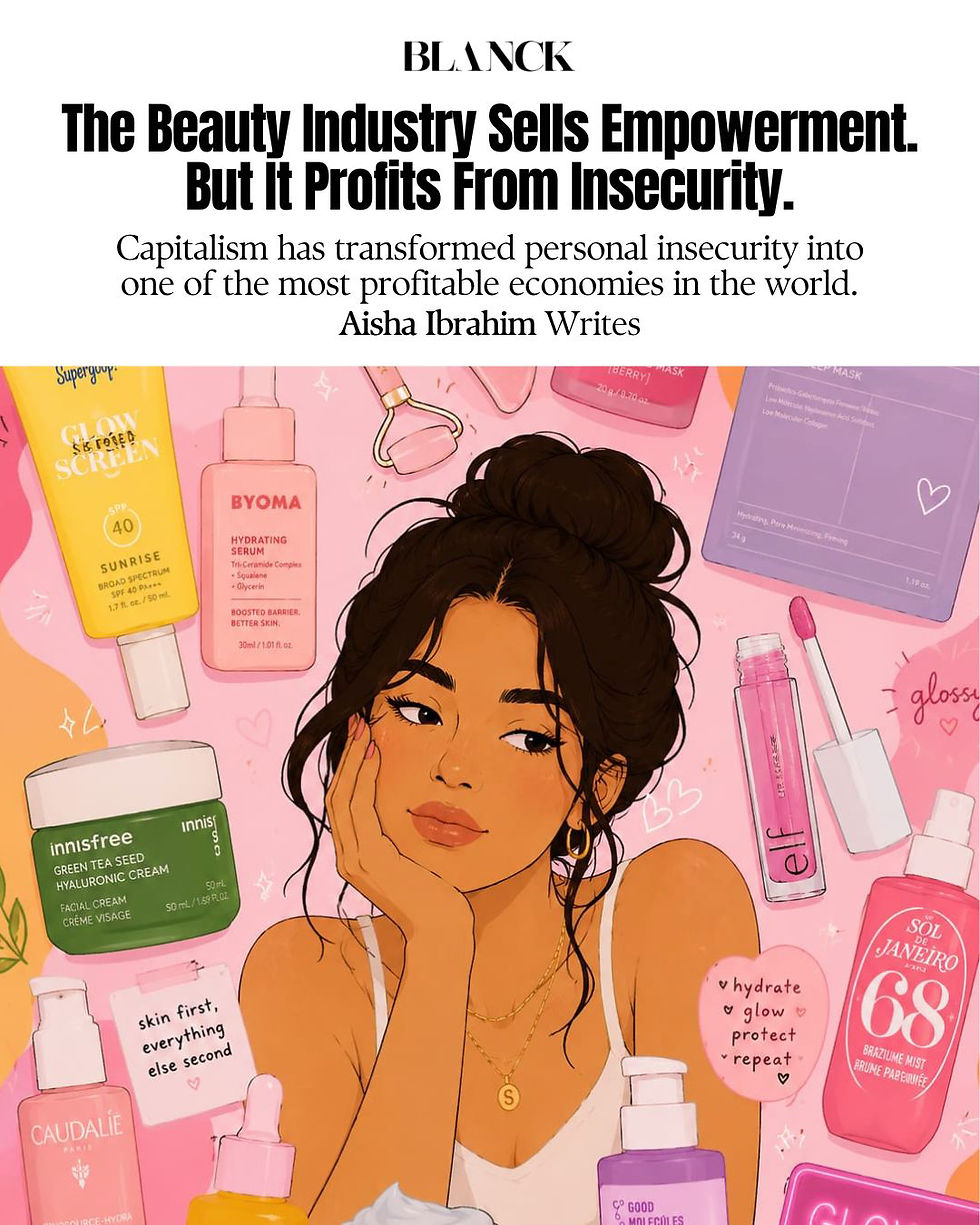
The global beauty and personal care industry is valued at roughly $600–650 billion, while Africa’s beauty market alone generates an estimated $60–70 billion annually. Cosmetic surgery and aesthetic procedures are also rapidly expanding, with Africa’s market projected to cross $1 billion by 2035.
This is no longer a niche industry. It is one of the largest consumer economies in the world and it does not run on satisfaction, it runs on maintenance.
In 2024 alone, nearly 38 million cosmetic procedures were performed globally, including millions of non surgical treatments like Botox and fillers. These are no longer rare interventions. They are routine upkeep.

The modern beauty economy depends on repeat appointments. Correction. Enhancement. Prevention. Reversal. Not completion.
What makes it more interesting is how the language keeps evolving. Procedures once considered extreme are now marketed as casual self care. Facelifts are described as “refreshing.” Fillers become “tweakments.” Surgery is rebranded as wellness. Even insecurity itself has undergone a luxury rebrand.
And that is where capitalism becomes subtle. It rarely tells people they are not enough directly. Instead, it reframes insecurity as self improvement.
Every few months, there is a new flaw to fix. Fuller lips. Smaller noses. Glass skin. Anti aging products for people barely in their twenties. The standard keeps shifting because if people ever felt fully satisfied with themselves, entire industries would slow down overnight.
Many of these things were once considered completely normal. Smile lines were signs of aging, not “problems.” Thin lips, wide noses, round faces, forehead lines, none of these were treated as defects requiring correction on a mass scale.

Over time, industries learned how to commercialize normal human features by reframing them as insecurities first, then selling solutions after. What once existed naturally now exists as something to manage, reduce, tighten, smooth, lift, or prevent
Social media only accelerated the cycle. Filters became beauty standards, faces became trends, human features now move through trend cycles the same way fashion does.
The result is a generation hyper aware of every pore, line, asymmetry and angle of their faces. People are not necessarily becoming more confident. They are becoming more fixated.
And yet the irony remains. The closer beauty culture moves toward “perfection,” the less satisfied people seem to feel because the standard is always designed to shift
This is the contradiction at the center of modern beauty culture: an industry that markets empowerment while quietly depending on dissatisfaction to survive.


Comments