.png)


German-Nigerian Designer Buki Akomolafe Speaks Candidly About Luxury, Sustainability and Why Slowing Down Is a Radical Act
- frankachiedu
- 1 day ago
- 5 min read


In a fashion industry increasingly defined by speed, consumption and relentless production cycles, German-Nigerian designer Buki Akomolafe is choosing a different path. For Akomolafe, fashion was never simply about clothes. Long before she launched a brand or showcased her work in galleries and exhibitions, she was a curious child fascinated by the details of how people dressed, particularly their shoes. By her teenage years, that fascination had evolved into creation. She began designing her own garments, bringing her sketches to life with the help of her mother, who would knit and sew the pieces she imagined.
"My first creation was a wrap skirt," she recalls. "I still remember the pride I felt in making something with my own hands."
Those early experiences laid the foundation for a design philosophy rooted not only in creativity, but also in craftsmanship, care and intention.
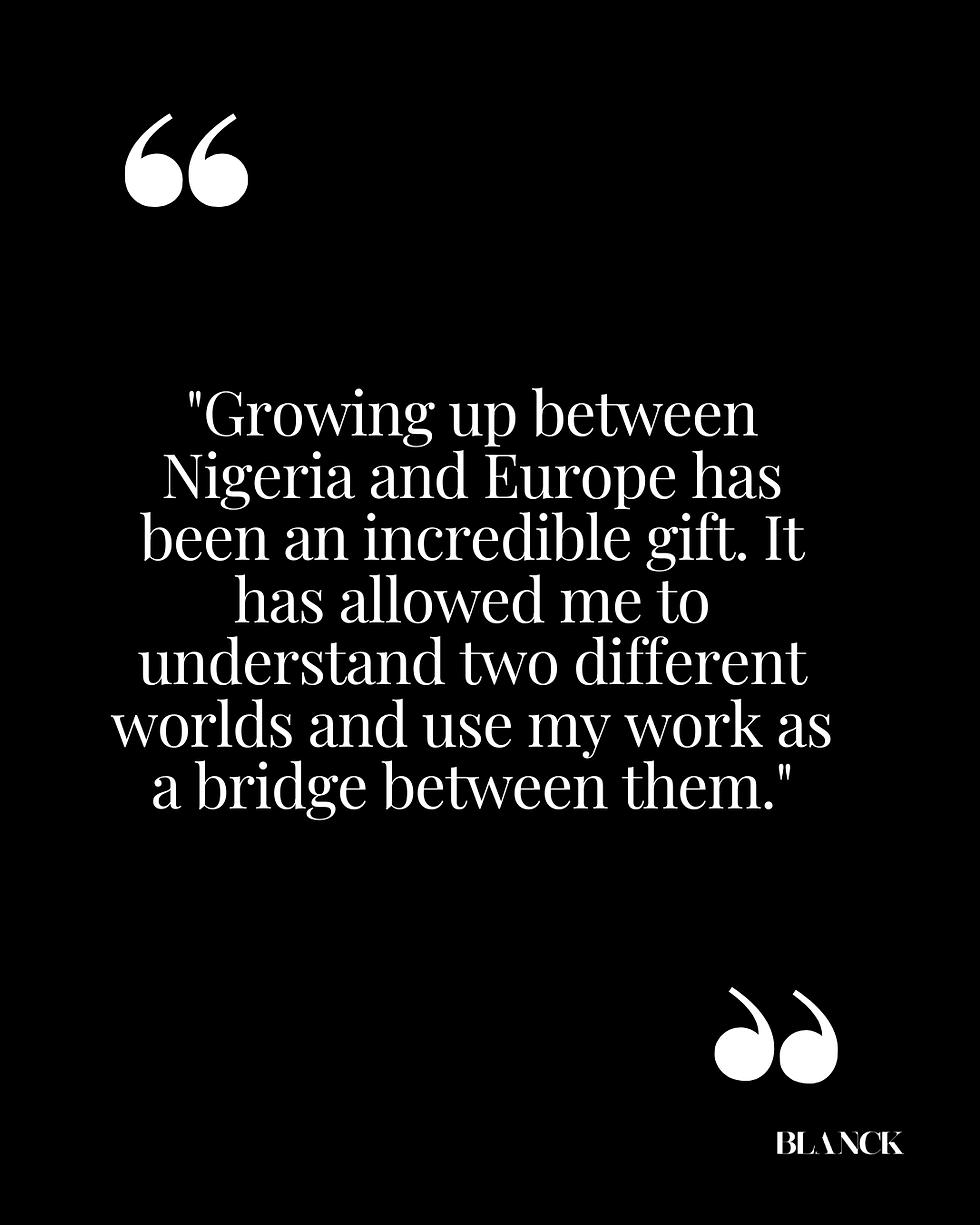
Born to a Nigerian father and a German mother, Akomolafe grew up between Nigeria and Europe, navigating two cultures, two identities and two distinct ways of seeing the world. While life in Nigeria taught her resourcefulness, community and an appreciation for limited resources, Europe offered a different perspective shaped by structure, accessibility and abundance.
Rather than viewing these experiences as opposing forces, she has embraced them as complementary influences. Today, her dual heritage sits at the heart of her brand, informing a creative language that explores belonging, sustainability, cultural exchange and craftsmanship. Through her work, she seeks not only to tell her own story but to create spaces where others can feel seen, represented and connected across borders.

In conversation with Blanck Magazine, Akomolafe reflects on the lessons Nigeria taught her about sustainability, the importance of creating visibility for Black creatives, and why slowing down may be the most radical act in contemporary fashion.
While a visit to a fashion school first convinced her to pursue design professionally, it was her growing discomfort with the industry's obsession with speed and mass production that ultimately shaped the designer she would become.
"I felt frustrated by a system that prioritised numbers over artistry and sustainability," she says. "I craved a slower, more intentional approach."
That philosophy continues to guide her work today.
Growing up between continents gave Akomolafe a unique lens through which to understand both creativity and consumption. Raised in an environment where resources could not be taken for granted, she learned early to value what was available. Food was often grown at home, water and electricity were carefully managed, and waste was something to be avoided rather than ignored. Those experiences stood in stark contrast to life in Europe, where abundance can often create distance between people and the resources they consume.

Those experiences stood in stark contrast to life in Europe, where abundance can often create distance between people and the resources they consume.
This awareness has become one of the driving forces behind her approach to sustainability. For Akomolafe, sustainability is not a trend or marketing strategy. It is a way of living rooted in mindfulness, responsibility and respect-for people, resources and the environment.
The designer deliberately rejects the relentless pace that dominates much of contemporary fashion. Instead of chasing multiple collections each year, she advocates for thoughtful creation and meaningful production.
To her, true luxury has little to do with exclusivity or excess.
"Luxury is about slowing down," she says. "Being fully present in the moment and allowing yourself the space to rest."
It is a perspective that feels increasingly radical in a world driven by algorithms, deadlines and constant consumption. While many brands compete to produce more, Akomolafe is encouraging consumers to consider whether less might actually be more.

This awareness has become one of the driving forces behind her approach to sustainability. Rather than viewing sustainability as a trend or marketing strategy, Akomolafe sees it as a way of living. It is a philosophy rooted in mindfulness, responsibility and respect-for people, resources and the environment. The designer deliberately rejects the relentless pace that dominates much of contemporary fashion. Instead of chasing multiple collections a year, she advocates for thoughtful creation and meaningful production.
To her, true luxury has little to do with exclusivity or excess.
"Luxury is about slowing down," she says. "Being fully present in the moment and allowing yourself the space to rest." It is a perspective that feels increasingly radical in a world driven by algorithms, deadlines and constant consumption. While many brands compete to produce more, Akomolafe is asking consumers to consider whether less might actually be more.

Her commitment to slowness and reflection was recently brought to life through her participation in Diaspora Wonderland: Fashioning Worlds at Berlin's IFA Gallery. Unlike the whirlwind atmosphere of fashion weeks, exhibitions offer something she believes is increasingly rare: time.
For Akomolafe, the exhibition became an opportunity to invite visitors into her creative process rather than simply present finished work. Through sketchbooks, inspirations, notes and personal reflections, audiences were given access to the world behind the garments.
"I've brought a piece of my studio into the gallery space," she explains.
The result was an experience that encouraged visitors to pause, reflect and connect with the work on a deeper level-an embodiment of the very values she hopes to champion through fashion.
Representation and inclusion are equally central to her practice. Living and working in Berlin, she became increasingly aware of how limited the fashion conversation could be for Black and diasporic creatives.
Determined to challenge that reality, she partnered with fellow creatives to launch Black in Fashion, an initiative held during Berlin Fashion Week that provided a platform for Black designers and artists to showcase their work, exchange ideas and engage in meaningful dialogue.
What began as a desire to create visibility quickly revealed something larger.
"There was a profound hunger for these kinds of spaces," she says.
The project reinforced her belief that fashion can serve as a bridge between cultures, experiences and perspectives. For Akomolafe, representation is not simply about visibility. It is about expanding narratives, creating opportunities and ensuring a wider range of voices contribute to shaping the future of the industry.

Looking ahead, her ambitions extend beyond Europe. One of her greatest aspirations is to deepen her connection with Nigeria and the wider African fashion ecosystem—not merely as a source of inspiration, but as a place of collaboration, exchange and creation.
She dreams of working closely with artisans across West Africa, blending traditional craftsmanship with contemporary design in ways that honour heritage while embracing innovation.
It is a vision that reflects the duality that has always defined her work: rooted in history while looking firmly towards the future.
At a time when fashion finds itself grappling with questions of sustainability, identity and purpose, Buki Akomolafe offers an alternative path. One built not on endless consumption but on intention. Not on speed but on presence. Not on trends but on connection.
In a culture that constantly demands more, her most powerful statement may simply be this: slow down.
And perhaps that, more than anything else, is the ultimate luxury.


Follow Buki Akomolafe's Journey Here
Follow Blanck On Social Media Here



Comments